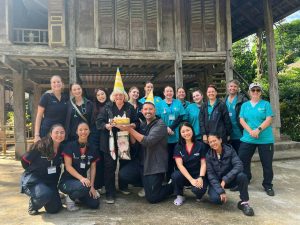
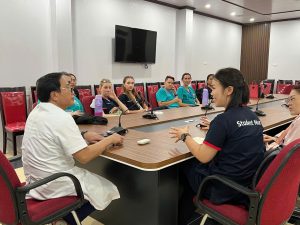
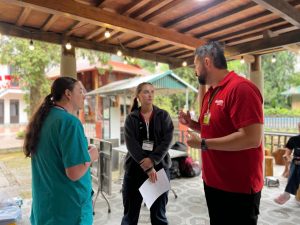
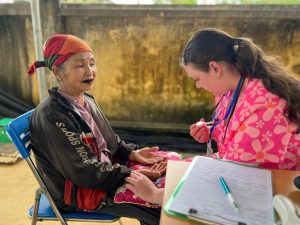
During our recent Health Care Placement, we had the opportunity to work alongside educators who played an important role in guiding students through unfamiliar, and often challenging, real-world contexts.
Beyond the clinical exposure, what stayed with us were the quieter moments — when students began to connect what they had learned in the classroom with the realities of healthcare in the community.
We invited Wesley Woodborne, a Registered Nurse (Emergency) and Lecturer from Griffith University, to share a few reflections from his perspective.
Q: Hi Wesly, thank for spending time talking with us today. Can you please share with us what were the most valuable learning outcomes you observed in your students during this programme?
A: There are many valuable learning outcomes this opportunity provides both myself and my students, but for me as an educator and a registered nurse, seeing the students learning how to think critically and use the clinical skills they have been taught in class and on placement to provide care to patients in this setting I think is the real valued learning outcome.
Q: How did this experience support or align with your academic or program objectives?
A:It allowed students to link community or primary healthcare practices to a community, providing education to patients and looking at chronic health concerns and management of patients in areas that are not easily accessible to healthcare professionals.
Q: From your perspective, how might this experience influence students’ future careers in healthcare?
A: It would show them that there is more than one area of nursing and the opportunities offered to nurses stretches globally, hopefully showing the positive impact nurses have in communities like the ones we visited.
Q: How was your experience working with us as a partner?
A: The experience was amazing, staff were supportive and encouraging both for students to learn terms and phrases, but also worked with us to provide the best ability to connect with the community and the patients. Staff were well versed in the culture, traditions and offered many opportunities to share that with our group.
We’re grateful to Wesley for sharing these reflections, and for the thoughtful role he played in supporting students throughout the programme.
Beyond the clinical exposure, what students carried with them were not just technical skills, but the ability to adapt, to communicate across cultures, and to approach care with greater awareness and empathy.
They learned to work in unfamiliar environments, navigate limited resources, and begin to see healthcare not only as treatment, but as education, prevention, and long-term engagement with communities.